
According to r/burgers, most chicken burgers are not burgers:
A chicken sandwich contains an entire piece of chicken or filet, rather [sic] a ground and blended patty. A pulled chicken sandwich is also not a burger.
On paper, that leaves room for ground chicken. A minced patty is built exactly like a burger: ground meat, salted, formed, seared. In practice, the subreddit rejects those too. I’ve tried.
I’m going to keep calling it a chicken burger. I’ve been chasing a good one for most of my life, and I’m not about to lose the argument on a technicality.
Chicken mall guy
About forty years ago there was a guy in a mall food court who made the best crunchy chicken burger I’ve ever had. I don’t remember his name or his stall, so he’s just Chicken mall guy.
His patty was a chicken breast, medium-brined, in a dark, mealy, crunchy breading. It wasn’t a KFC-style flaky coating. It was closer to cornmeal: gritty, fried hard, and deeply browned. I don’t remember the condiments at all. Probably lettuce and mayo, maybe tomato. It didn’t matter, because the patty carried the whole burger.
He went out of business, and I’ve been trying to find that crunch ever since.
The BK years
In the late 80s and early 90s I worked at Burger King, which meant I ate a lot of BK. Two chicken sandwiches from that era set my expectations for everything since.
The first was the Chicken Specialty Sandwich, the long one, now sold as the Original Chicken Sandwich. It was a minced patty, lightly breaded, deep-fried, and pepper-forward, served on a long sesame bun with mayo and shredded lettuce. By any honest standard it was a low-quality patty. It still hit salt, pepper, and fat in exactly the right proportions. In our market it also came in variations: Italian, American, and French.
Here’s the strange part: they were best about an hour old. I usually ate between rushes, which meant I ate whatever had expired in the holding bin. After an hour, the deep-fried fat, the chicken juices, and the mayo had all worked into each other. They never went soggy. They just got better. There were days I ate four or more of these stupid things.
As a manager, I could build my own, so I made them Whopper style: onion, pickle, tomato, ketchup, the works. That version was even better, and I still order one that way every four or five years.
The second was the BK Broiler, a “chicken breast” patty that was really chunks of brined breast glued together into a patty shape. It was soft and salty, with lettuce, tomato, and a ranch-style sauce. The bun was too soft for my taste, but the whole thing had a very chill vibe. It was the relaxed cousin of the fried sandwich.
The crunch camp
The McChicken and Wendy’s Spicy Chicken Sandwich brought the crunch. They’re salty, crispy, and one-note. Once the crunch is gone, there’s nothing left to find.
These days, a good pub fried chicken sandwich does the same job much better. It’s the McChicken concept with real seasoning under the coating, which is roughly what Chicken mall guy was doing.
The Subway sub
The last reference point is Subway’s roasted chicken sub: floppy pressed patties of brined breast, with mayo, BBQ sauce, mustard, and raw onion, and fully dressed with lettuce, pickles, and tomato. It’s sweet, sharp, and tangy, with enough onion bite to cut through the sauce. It’s not a burger, but it taught me more about builds than any of the burgers did.
Fast food chicken is engineered
It took me years to understand why a homemade chicken breast on a bun never tasted like any of these. The answer is that none of them were a plain piece of chicken. They were engineered.
The Broiler’s glued-together chunks are a salt trick. Salt draws a protein called myosin out of the muscle, and when you mix or tumble the meat, that protein turns sticky and binds the pieces together. When my recipes say “mix until the meat turns tacky,” that’s the same glue.
The juicy, slightly processed bite of the BK patty is a pH trick. Commercial patties use phosphates; at home, a little baking soda and some added water do the same job, raising the pH so the meat holds onto moisture. It’s a dial. A little gives a juicy patty that still eats like chicken, which is where the BK classic sat. A lot, worked hard with salt, turns bouncy like a Vietnamese beef ball or a fish ball: good, but closer to sausage than burger.
The brine is the third trick. The Broiler and the Subway chicken were both brined or injected, which is why they stayed salty and juicy all the way through.
Once I understood those three tools, I could build every one of these at home.
The texture scale
My perfect chicken burger isn’t one patty. It’s a spot on a texture scale, and every sandwich above lands somewhere on it.
| Texture | Reference | At home |
|---|---|---|
| Mega crunch | Chicken mall guy | Pan-fried chicken burger, double-coated |
| Crunch | McChicken, Wendy’s spicy, a good pub sandwich | Brined breast, breaded and fried |
| Fried and floppy | BK classic, an hour old | Minced breast, lightly breaded |
| Floppy whole cut | BK Broiler, Subway | Breast, dry-brined in the Mayo marinade |
| Floppy and sausage-like | Fish balls, not burgers | Chicken patties, worked until tacky |
Three choices move a patty along the scale. The cut is minced breast, whole breast, or thigh. The coating is none, a light breading, or a double coat. The salt either brines a whole cut, which keeps it tender and floppy, or gets worked into mince until it binds, which pushes it toward sausage. The BK classic shows that mince doesn’t have to go all the way: it was minced breast, but it never ate like a sausage.
Thigh works at every step, breaded, bare, or brined, and forgives more overcooking than breast.
The whole cuts are fast. A butterflied breast in the Mayo marinade is a dry brine with a coat: the salt seasons the meat, and the mayo binds emulsified oil and vinegar to the surface. It takes five minutes to prep and thirty to marinate, so that’s my weeknight sandwich. Mince is the most work, so I make it when I find ground chicken on sale.
The top of the scale is still unfinished. The double coat of flour dredge, loose cornstarch batter, and breadcrumbs is properly crunchy, but it isn’t Chicken mall guy’s crunch. A cornmeal breading is next on my list.
Four builds
The patty is only half the burger. Each build is a different way of contrasting it.
Deluxe (Whopper style). Raw onion, pickle, tomato, cold lettuce, ketchup, and mayo. This is the build that made a cheap BK patty great, and it works anywhere on the scale. The onion is the most important part.
Bacon and Swiss. Smoke and more fat, piled onto a fatty patty. It needs mustard or a sharp pickle, or it turns heavy by the third bite.
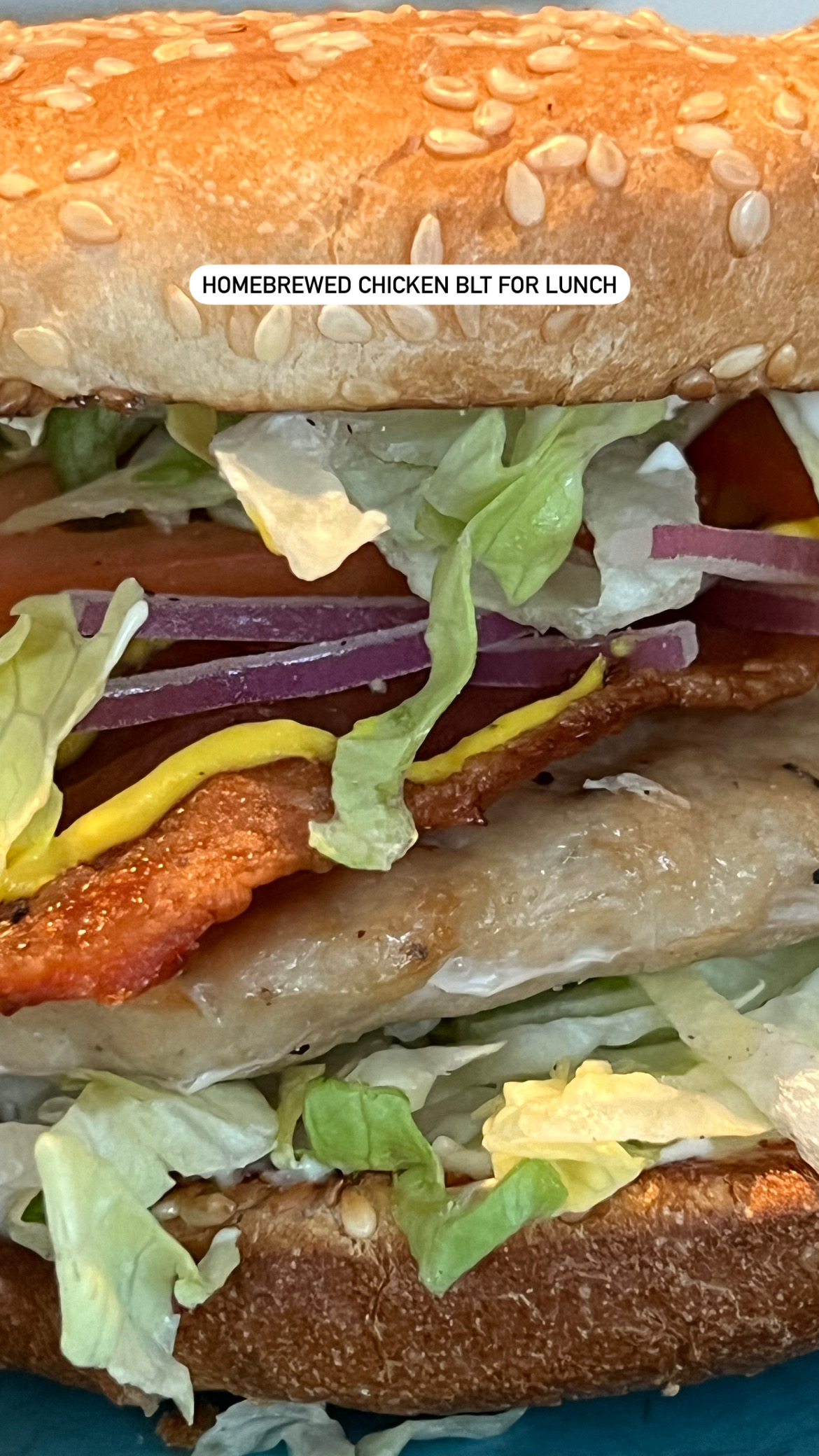
Sweet pickle and mustard. Bread-and-butter pickles with yellow mustard, or honey mustard if you want it sweeter. It’s the simplest build, and it’s all about sweet and sharp landing at the same time.
BBQ and onion. The Subway sub on a bun. Sweet, smoky sauce against raw onion bite. It works best on the softer patties; heavy sauce on a crunchy patty eats the crunch.
The rule under all of it
Every combination that works follows the same pattern. The patty brings salt, fat, and savoury depth, plus a spot on the texture scale. Then the build adds something cold and crunchy (lettuce, raw onion, pickle) and something sharp (onion, mustard, vinegar).
Skip the cold crunch and you get a McChicken: fine, but one note. Skip the sharpness and you get a bacon Swiss burger that you regret by the third bite. Get both and you can forgive a mediocre patty, which is exactly what a Whopper-style BK chicken taught me in 1990.
Pick the patty by how much time you have. Pick the build by mood. Toast the bun, and don’t forget the onion.
The quest is impossible, of course. The perfect chicken burger was an hour-old BK sandwich eaten between rushes at nineteen, or a crunchy patty from a food court stall that closed forty years ago. I’ll never taste either again, and that’s okay. The home versions are better anyway.